
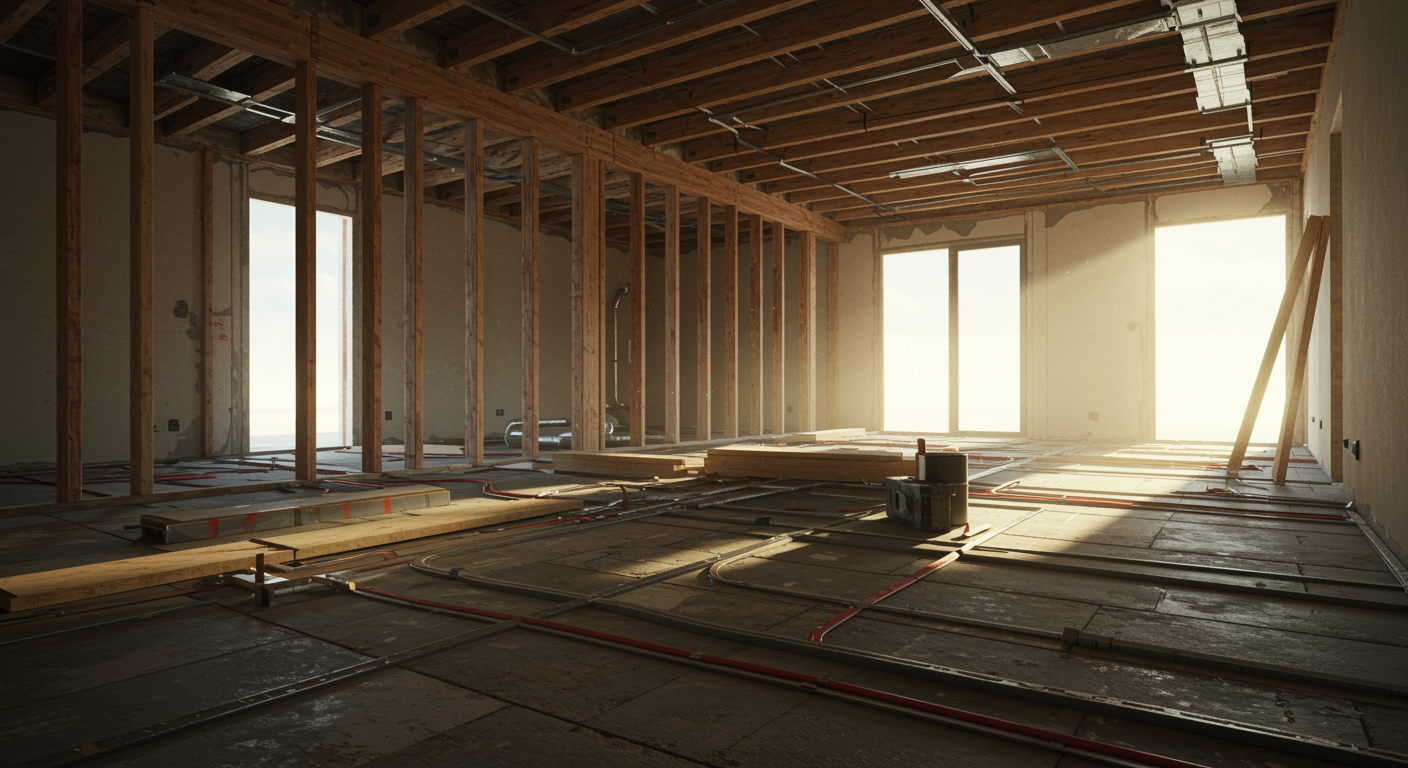
When homeowners talk about “opening up a space” or “lifting the floor,” what they usually imagine is the final result — brighter rooms, better flow, cleaner lines.
What they don’t see is the sequence behind it.
Structural remodeling isn’t demolition first and decisions later. It follows a precise order. And when that order is respected, the result is not just beautiful — it’s safe, durable, and properly integrated.
Let’s break down the real process.
1. Investigation Before Demolition
Before a single wall comes down or floor is lifted, we assess:
- Is the wall load-bearing?
- What mechanical systems run through it?
- Has the floor settled?
- Is there subfloor damage?
- What’s happening in the crawlspace or below the slab?
Especially in older homes throughout Asheville and Western North Carolina, floor sagging, moisture intrusion, and structural shifting are common. You don’t “open things up” until you know exactly what’s holding the house up.
2. Reinforcement: The Backbone of the Project
Once structural components are exposed, reinforcement comes first.
This may involve:
- Installing LVL beams
- Adding support posts
- Sistering joists
- Replacing damaged subfloor
- Adjusting load paths
- Adding temporary shoring before wall removal
This is the part most homeowners never see — but it determines whether your open floor plan will stand the test of time.
If you remove a load-bearing wall without redistributing its load properly, the result isn’t just cosmetic cracking. It can mean structural compromise.
Reinforcement is not optional. It’s engineered sequencing.
3. Rough-In: The Systems Layer
After structure is stabilized, the mechanical rough-ins begin.
This includes:
- Electrical rewiring and panel adjustments
- Plumbing relocations and vent rerouting
- HVAC duct modifications or new returns
Here’s where many projects go wrong: homeowners underestimate the domino effect.
Move one wall?
You likely move:
- Switches
- Outlets
- Lighting circuits
- Plumbing lines
- Ductwork
If floors are lifted, that opens access — but it also means the subfloor must be rebuilt to code after systems are installed.
Rough-ins happen before insulation and drywall because once walls are closed, corrections become expensive.
4. Rebuild: Bringing It Back Together
Only after reinforcement and rough-ins are complete do we move into rebuild.
That includes:
- Subfloor replacement or leveling
- Framing adjustments
- Insulation
- Drywall installation
- Finishes (tile, flooring, paint, cabinetry)
At this stage, the transformation becomes visible.
But the reason it looks seamless?
Because the sequence was respected.
Why Sequence Matters More Than Speed
In structural remodeling, rushing the process creates:
- Uneven floors
- Cracked drywall
- Door misalignment
- Future moisture problems
- Failed inspections
Following the proper sequence ensures:
✔ Structural integrity
✔ System efficiency
✔ Code compliance
✔ Long-term durability
✔ A clean, open layout that actually performs
The Truth About Floor Lifting and Wall Moving
When floors need to be lifted, it’s rarely just cosmetic.
It could mean:
- Joist failure
- Water damage
- Foundation shifting
- Inadequate original framing
When walls are moved, you are altering the load path of the house.
This is not demolition — it’s recalibration.
Structural remodeling is not about removing things.
It’s about redistributing forces safely and intentionally.
Final Thought
A beautiful open-concept space is built on what you can’t see:
Reinforced structure.
Integrated systems.
Careful sequencing.
Rough-in.
Reinforcement.
Rebuild.
When done in the right order, your home doesn’t just look different — it performs better.