
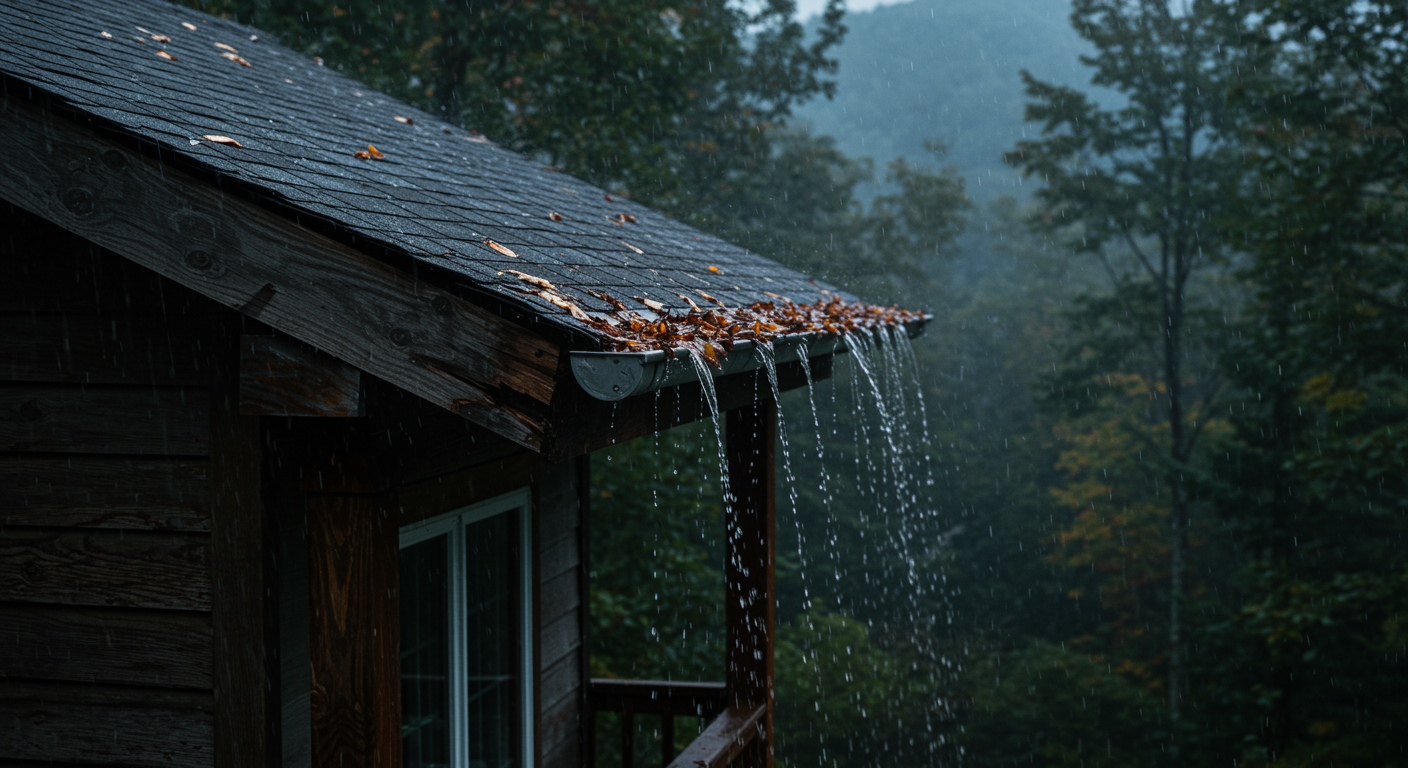
If you live in Asheville, clogged gutters aren’t a once-a-year problem—they’re a cycle.
Between the dense tree coverage and the unpredictable rain patterns rolling through the Blue Ridge Mountains, your gutters are constantly under pressure. And if they’re not working properly, the damage doesn’t just stay in the gutters—it starts creeping into your roof.
🍂 Why Your Gutters Keep Failing (Even After You Clean Them)
Most homeowners think the solution is simple: clean the gutters, problem solved.
But here’s the reality:
- Leaves and debris build up faster in wooded areas
- Sudden downpours overwhelm standard gutter systems
- Poor pitch or undersized gutters can’t keep up
- Downspouts clog or drain too close to the foundation
So even if you cleaned them a few months ago, there’s a good chance they’re already backing up again.
👉 This isn’t just a maintenance issue—it’s a system design issue.
🌧️ What Happens When Gutters Overflow
When gutters clog, water has nowhere to go. So it spills over the edges—and that’s where the real problems begin:
- Water runs down your siding, causing stains and deterioration
- Soil erosion forms around your home’s perimeter
- Water pools near the foundation
- Entryways and walkways become muddy and hazardous
But the most overlooked damage? It starts right at the roofline.
🏚️ Roof Damage Always Starts at the Edges
Your roof doesn’t usually fail in the middle. It fails at the edges—where your gutters are supposed to protect it.
When gutters are clogged or failing:
- Water backs up under your shingles
- Fascia boards begin to rot
- Moisture seeps into the roof decking
- Mold and mildew start forming in hidden areas
Over time, this leads to leaks, structural damage, and premature roof replacement.
👉 What started as a clogged gutter can turn into a full roofing issue.
💸 The Hidden Cost of Ignoring It
Let’s break it down:
- Gutter repair or upgrade → relatively low cost
- Roof repair → significantly higher
- Interior water damage → even worse
Many homeowners don’t realize the connection until water is already inside the home.
And by then, you’re no longer fixing gutters—you’re dealing with ceilings, insulation, and structural repairs.
🌄 Why This Hits Asheville Homes Harder
Homes in Asheville face a unique combination:
- Heavy rainfall
- Sloped terrain
- Tree-dense lots
Water doesn’t just fall—it moves fast. And if your gutter system isn’t designed to handle that flow, it will fail repeatedly.
👉 That’s why “just cleaning” your gutters often isn’t enough here.
✅ What Actually Solves the Problem
Instead of constantly reacting, the goal is to fix the system:
- Proper gutter sizing for high water volume
- Correct pitch to ensure consistent flow
- Strategic downspout placement (especially on slopes)
- Gutter guards to reduce debris buildup
- Reinforced fascia where needed
This turns your gutters from a recurring headache into a reliable protection system.
🔑 Final Thought
If your gutters keep clogging, it’s not bad luck—it’s a sign something isn’t working.
And in a place like Asheville, ignoring it doesn’t just mean dealing with water overflow.
It means risking your roof—starting at the edges, where the damage is easiest to miss and most expensive to fix.